
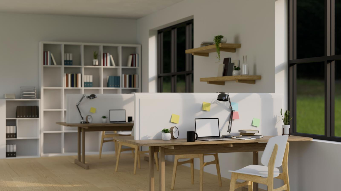
For years, productivity advice has focused on managing time better. Calendars, to-do lists, productivity apps, and frameworks promise to help people do more in less time. Yet despite having more tools than ever, many professionals feel increasingly distracted, mentally fatigued, and unable to focus deeply.
The issue is no longer a lack of discipline or poor time management. It is the environment in which work is being done.
As work has moved out of traditional offices and into homes, cafés, and hybrid setups, productivity has become less about scheduling tasks and more about designing the conditions under which meaningful work can actually happen.
Why Time Management Alone No Longer Works

Time management assumes one thing above all else: that the environment is neutral. In reality, it is not. A well-structured day means very little if it is spent in a space filled with interruptions, noise, visual clutter, and constant context switching. When the environment demands attention, cognitive energy is spent on coping rather than creating.
This is why many professionals report working longer hours while accomplishing less. The problem is not effort. It is friction.
The Cognitive Cost of Poor Work Environments
Every environment places a mental load on the people inside it.
At home, this often includes:
- Household noise and interruptions
- Blurred boundaries between personal and professional life
- Constant visibility of non-work responsibilities
In traditional open offices, the issues are different but equally disruptive:
- Background conversations
- Lack of privacy
- Frequent interruptions disguised as collaboration
Over time, these conditions reduce the brain’s ability to sustain focus. Productivity suffers not because people are lazy, but because the environment is constantly competing for attention.
What Environment Design Actually Means
Environment design is not about aesthetics alone. It is about intentionally shaping space to support how the brain works.
Effective work environments are designed to:
- Minimise unnecessary stimulation
- Protect periods of uninterrupted focus
- Create psychological separation between different modes of life
- Support clarity rather than demand attention
This is why the same person can feel unfocused in one space and highly productive in another, even with the same tasks and schedule.
Why Home Was Never Designed for Deep Work
Homes are designed for comfort, not concentration.
They encourage relaxation, multitasking, and emotional connection. These are valuable qualities, but they conflict with the mental state required for deep, professional work.
When work enters the home:
- Rest spaces lose their restorative function
- Professional boundaries weaken
- Cognitive recovery becomes harder
Over time, this leads to fatigue rather than flexibility.
Many professionals are not seeking a return to traditional offices. They are seeking an environment that allows them to think clearly again.
The Shift Toward Intentional Workspaces
A new category of workspace is emerging — one that prioritises intention over energy.
These environments are characterised by:
- Quiet zones and sound-controlled spaces
- Private or semi-private work areas
- Minimal visual noise
- Thoughtful layouts that reduce interruption
The goal is not constant interaction, but sustained focus.
This shift reflects a deeper understanding of productivity: meaningful work requires mental safety, not constant stimulation.
Why Focus Is Becoming a Premium Resource
In a world of constant notifications, meetings, and information overload, uninterrupted focus has become rare.
As a result, it is increasingly valuable.
Professionals who rely on thinking — therapists, consultants, founders, doctors, writers — do not need high-energy environments. They need spaces that respect attention and confidentiality.
For them, productivity is not about doing more tasks. It is about doing fewer things, better.
Spark Plug’s Philosophy on Productivity
At Spark Plug, productivity is viewed as an outcome of environment, not pressure.
The spaces are designed to:
- Reduce noise and visual distraction
- Support deep, uninterrupted work
- Offer privacy where confidentiality matters
- Create a clear separation between work and home
Rather than forcing productivity through rigid systems, the environment itself does the heavy lifting.
This approach recognises that the best work often happens quietly.
Why the Future of Work Is Environment-Led
As hybrid and flexible work become the norm, the question is no longer where people work, but how their environment supports the way they think.
Workspaces that prioritise intention, calm, and clarity will outperform those built around constant activity and noise.
In the future, productivity will belong to those who design their environments as carefully as they design their schedules.
Conclusion: Redefining Productivity for Modern Work
Time management will always matter. But it is no longer enough. True productivity depends on creating conditions where focus is possible, decisions are clear, and mental energy is protected. Environment design is not a luxury. It is a productivity strategy.
For professionals who value depth over distraction, the right space is not optional. It is essential.